
Demolition Equipment List: What You Need at Each Job Size
Updated: 5 hours ago
Starting or growing a demolition business can feel like a balancing act. You need enough equipment to handle projects safely and efficiently, but you don't want to overspend on machines that sit idle between jobs. Whether you're tearing down a small garage or dismantling a large commercial structure, choosing the right equipment is critical to profitability.

This demolition equipment list breaks down the essential machines, attachments, tools, and support equipment needed for projects of different sizes. Understanding what equipment fits each job type can help contractors control costs, improve production, and reduce risk on the jobsite.
Why the Right Demolition Equipment Matters
Demolition is more than simply knocking down a building. Contractors must manage debris, maintain site safety, coordinate trucking, protect nearby structures, and often work around utilities, roads, and occupied buildings.
The right demolition equipment helps you:
Complete projects more efficiently
Improve worker safety
Reduce labor costs
Minimize equipment downtime
Increase productivity
Meet demanding project schedules
From residential tear-downs to large industrial demolitions, the equipment requirements can vary dramatically.
Plan Before Equipment Arrives
Before bringing equipment to any demolition site, contractors should complete several important steps.
These may include:
Calling 811 for utility locates
Reviewing permit requirements
Identifying hazardous materials
Planning debris removal routes
Verifying site access
Coordinating with property owners and GCs
Underground utility strikes can create significant delays, property damage, and injury risks. Utility verification should always be part of your pre-demolition planning process.
External Resource: https://www.call811.com
Small Demolition Projects
Small demolition jobs often include:
Detached garages
Sheds
Mobile homes
Small houses
Swimming pools
Concrete patios
Driveways
For these projects, versatility is often more valuable than sheer machine size.
Mini Excavator
A mini excavator is one of the most useful machines for smaller demolition work.
Advantages include:
Easy transportation
Excellent maneuverability
Lower fuel consumption
Ability to work in confined spaces
Multiple attachment options
Mini excavators are commonly used for structure removal, foundation demolition, grading, and trenching work.
Skid Steer or Compact Track Loader
A skid steer or compact track loader is often paired with a mini excavator.
Common tasks include:
Loading debris
Moving materials
Managing spoil piles
Site cleanup
Dumpster loading
Compact track loaders are especially useful in muddy conditions or soft ground often found on residential sites.
Explore more in our blog: Compact Equipment for Tight-Access Jobs: Working in Backyards
Hydraulic Breaker Attachment
Concrete removal is common on demolition projects.
Hydraulic breakers help contractors remove:
Sidewalks
Driveways
Footings
Slabs
Small foundations
Many contractors pair breakers with mini excavators or skid steers depending on the application.
Roll-Off Dumpsters
Debris management is often overlooked during bidding.
Having sufficient dumpster capacity helps prevent:
Site congestion
Production delays
Excess material handling
Efficient waste removal can have a major impact on project profitability.
Medium-Sized Demolition Jobs: Building a Productive Fleet
Medium-sized projects may involve:
Commercial buildings
Multi-family structures
Small industrial facilities
Larger residential developments
Schools and retail spaces
At this level, production becomes increasingly important.
Mid-Size Excavator
A mid-size excavator often serves as the primary demolition machine.
Benefits include:
Greater reach
Increased lifting capacity
Better attachment performance
Faster material processing
Depending on the structure, contractors may use excavators in the 20- to 40-ton range.
Explore more in our blog: Excavator Sizes Explained: Mini to Mass Excavation Classes
Demolition Grapple
A demolition grapple improves both safety and productivity.
Common uses include:
Separating materials
Loading trucks
Handling steel
Sorting concrete debris
Controlled dismantling
The ability to sort materials during demolition may also improve recycling opportunities.
Hydraulic Thumb
A hydraulic thumb turns an excavator into a highly efficient material-handling machine.
Contractors frequently use thumbs for:
Picking rubble
Loading trucks
Moving structural components
Managing spoil piles
Wheel Loader
Wheel loaders become valuable when debris volumes increase.
Typical tasks include:
Stockpiling material
Feeding crushers
Loading dump trucks
Site cleanup
Wheel loaders offer speed that excavators cannot always match for material movement.
Water Truck
Dust control is a major concern on commercial demolition sites.
Water trucks may help contractors:
Control airborne dust
Improve visibility
Reduce nuisance complaints
Support regulatory compliance
Contractors should also review applicable dust control standards through OSHA at https://www.osha.gov.
Large Demolition Jobs: Heavy Production Equipment
Large demolition projects often include:
High-rise structures
Manufacturing facilities
Warehouses
Large industrial plants
Shopping centers
Large institutional buildings
These projects require specialized equipment focused on reach, power, and safety.
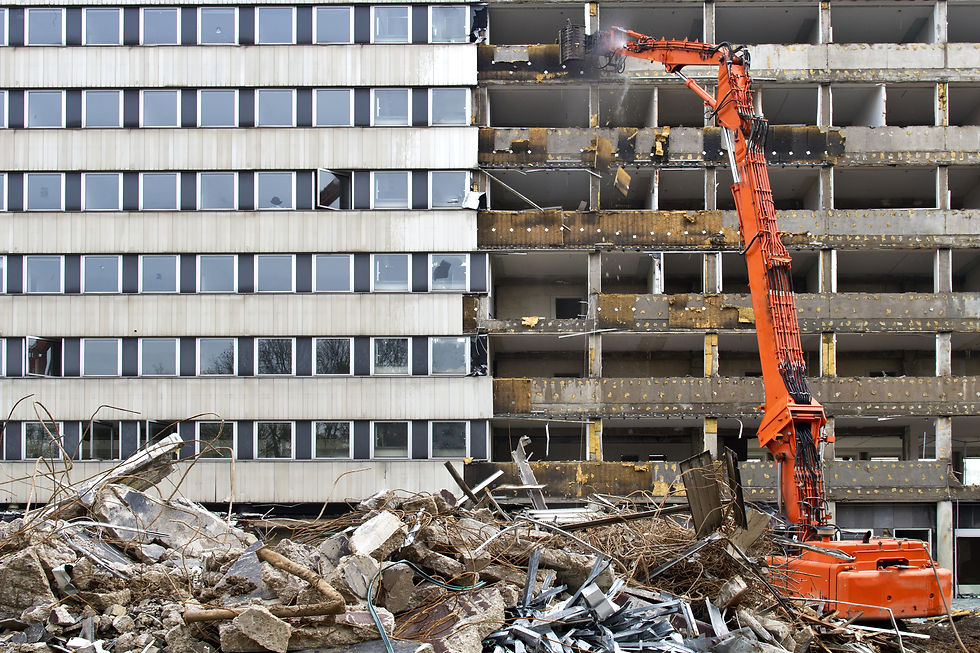
High-Reach Demolition Excavator
One of the most important pieces on large projects is the high-reach demolition excavator.
These machines are designed to:
Reach upper floors
Handle structural demolition
Improve operator visibility
Allow controlled demolition from safer distances
High-reach equipment is often used when conventional excavators cannot safely access elevated demolition areas.
Large Material Handler
Material handlers are designed to move significant volumes of debris quickly.
Advantages include:
Extended reach
Faster sorting
Increased loading efficiency
Better visibility for operators
They are commonly used in large commercial and industrial demolition operations.
Mobile Crusher
For concrete-heavy projects, a mobile crusher may provide significant operational benefits.
Crushers can process:
Concrete
Brick
Asphalt
Aggregate materials
Processed material may potentially be reused on-site depending on project specifications and local requirements.
Shear Attachment
Hydraulic shears are commonly used for structural steel demolition.
They can cut:
Structural beams
Rebar
Steel framing
Metal components
This attachment is especially valuable on industrial demolition projects where metal separation is required.
Long-Reach Excavator
Some demolition sites present unique access challenges.
Long-reach excavators help contractors:
Reach across obstacles
Work near water
Access difficult areas
Demolish structures from safer distances

Support Equipment Every Demolition Contractor Should Consider
No demolition equipment list is complete without support equipment.
These assets may not generate revenue directly, but they often keep jobs moving efficiently.
Lowboy Trailer
Contractors need safe transportation for heavy equipment between job sites.
A lowboy trailer helps move:
Excavators
Loaders
Crushers
Specialized demolition machinery
Service Truck
Equipment downtime can quickly affect productivity.
A service truck allows crews to perform:
Fueling
Lubrication
Minor repairs
Routine maintenance
Generators and Lighting
Projects frequently require temporary power and lighting.
This is especially true for:
Interior demolition
Early morning work
Night operations
Remote job sites
Traffic Control Equipment
For roadside or urban work, contractors may need:
Cones
Barriers
Signage
Arrow boards
Requirements vary by state, municipality, and project owner.
Matching Equipment to Job Scope
One of the most common mistakes contractors make is mobilizing equipment based on availability rather than project requirements.
Before selecting equipment, consider:
Structure height
Material composition
Truck access
Debris volume
Recycling requirements
Utility conflicts
Schedule demands
A small residential teardown may only require a mini excavator and skid steer. A large industrial demolition project could require several excavators, a crusher, material handlers, water trucks, and multiple hauling units.
The most profitable contractors often focus on deploying the right equipment combination rather than simply bringing the biggest machines available.
Insurance Considerations for Demolition Equipment
Demolition work carries unique risks due to structural collapse hazards, debris handling, heavy equipment operation, and transportation exposures.
Contractors commonly review coverages such as:
Commercial auto insurance
Inland marine insurance for equipment
Umbrella liability insurance
Pollution-related coverage where applicable
For newer contractors, inland marine insurance is particularly important to understand. This coverage is commonly used to help protect mobile equipment while it is being transported or used away from a permanent location, subject to policy terms, conditions, and exclusions.
Coverage needs vary significantly based on equipment values, project size, operating states, and contract requirements. Always discuss your specific operation with a licensed insurance agent.
Conclusion
The best demolition equipment list depends on the size and complexity of the project. Small jobs may require little more than a mini excavator and skid steer, while large commercial demolition projects often need specialized equipment such as high-reach excavators, crushers, shears, and material handlers.
Carefully matching equipment to the job can improve productivity, control costs, and help crews complete projects safely and efficiently.
FAQ
What is the most important machine for demolition work?
For many contractors, the excavator is the primary demolition machine because it can perform demolition, material handling, loading, and site cleanup with the proper attachments.
What attachment is best for concrete demolition?
Hydraulic breakers are commonly used for breaking concrete slabs, foundations, sidewalks, and other reinforced concrete structures.
Do all demolition jobs require a high-reach excavator?
No. High-reach excavators are generally used on larger projects involving taller structures where additional reach and safety are needed.
Can a skid steer be used for demolition?
Yes. Skid steers are often used for debris removal, material handling, grading, and cleanup. With specialized attachments, they can perform additional demolition-related tasks.
What insurance do demolition contractors typically carry?
Ready to protect your demolition business and the equipment that keeps it running? Excavating Insurance Partners specializes in insurance for demolition, excavation, site work, and heavy equipment contractors across the U.S.
Request a free quote today https://www.excavatinginsurancepartners.com/quote
Comments